The wheel. The printing press. The telephone. The automobile. Aviation. Radio and television. The internet. These are among the transformative inventions that improved the quality of people’s lives and changed the course of human history. If you ask me, karaoke belongs on that list. But where did it come from?
The Japanese origins of karaoke are well-known, although the particular man who is credited with those origins has not become the household name that he deserves to be. Daisuke Inoue, an unassuming Osakan, gifted karaoke to the world in 1971. And yes, I would rank him right up there with the likes of Gutenberg and the Wright Brothers. 🙂
Fewer people are versed in the history of karaoke in the United States. Inoue’s invention reached critical mass in the U.S. in the 1990s, but its American presence dates back somewhat earlier than that. Appropriately enough, karaoke made its American debut near Hollywood, the global epicenter of the entertainment industry. The first venue not only in the United States, but in all of the Western hemisphere, to offer the chance to sing with pre-recorded instrumental accompaniment was the Dimples Supper Club (also known as Dimples Showcase) in Burbank, California.
Named for a Shirley Temple movie, Dimples opened its doors in 1982, and its customers have been singing their hearts out ever since. For anyone serious about conducting a World Karaoke Tour, Dimples is a required destination. If you want to explore La-La Land in all its glory, a visit to Dimples is just as integral to the Hollywood experience as the Universal Studios tour or Grauman’s Chinese Theatre.
Dimples is truly an institution in the Los Angeles area, and has forged a particularly robust connection with nearby Hollywood. Numerous television programs have spotlighted Dimples, and countless stars of TV and film, as well as musical recording artists, have graced its karaoke stage. Some of its walls are adorned with autographed photos of famous guests who’ve dropped by to sing. Oddly enough, one of the celebs who hangs out most frequently at Dimples is Dennis Haskins, who played Principal Richard Belding on the classic Saturday morning television series from the early 1990s, “Saved by the Bell” (he also reprised that role in the spinoff “Saved by the Bell: the New Class”). Hey, I said he was a celebrity; I didn’t say he was an A-lister. 🙂 But he deserves props for his excellent choice of hobbies. Here you can watch him doing a number by Tom Jones. Say what you will about Dennis Haskins, the man knows how to put on a show:
Haskins, who reportedly has been a regular at Dimples since 2002, has actually released a CD compilation of his karaoke stylings (you can also download the tracks individually as MP3s). But I digress.
I’ve been to Dimples twice so far: in November 2009, and July 2011. The decor of Dimples can best be described as . . . garish. The stage area is festooned with props, and singers are regularly encouraged to don bizarre hats and other unusual headgear. For example, the last time that I took to that stage, proprietor Sal Ferraro insisted that I wear a Viking helmet. Because apparently, nothing says “karaoke” like a pair of Viking horns protruding from your head. Naturally, I obliged.
One of the coolest features that Dimples boasts is its live video feed. If you’re singing on the Dimples stage at any time between 6:00 pm and 2:00 am, Pacific time, people all over the world can go online and watch your performance in real time! (another notable karaoke bar with a live webcam broadcasting from its stage is the Cats Meow in New Orleans. As you might expect, I’ve been to that legendary Big Easy karaoke joint too). In addition, after your song is finished, the Dimples management presents you with a free DVD and Polaroid photograph of your performance. Typically, the person bringing these mementoes to your table is Sal himself, who often goes by the moniker “Mr. Dimples” (Sal is an interesting man in many respects, who has visited over 100 countries, thereby qualifying him for membership in the prestigious Travelers’ Century Club. However, the Dimples website, while supplying this tidbit, does not indicate in how many of those countries he’s sung karaoke). Admittedly, the need for such recordings to be supplied by the establishment is greatly diminished in an age where everyone has a smartphone that shoots HD video. But it’s still a nice touch. Plus, the DVD is of superior quality to anything your inebriated friends are likely to produce.
Sal’s restaurant also offers an extensive dinner menu, and it’s certainly a nice bonus when the available victuals at a karaoke establishment extend beyond mere “bar food.”
Here’s a video from my first Dimples appearance, in November 2009. The song is “At this Moment” by Billy Vera & the Beaters, perhaps best known as the love theme for Alex P. Keaton and Ellen Reed on the 1980s sitcom “Family Ties.” I don’t know what the weird background noise is that sounds like running water (I pulled the video off the complimentary DVD that Dimples provided to me). But I wanted to include this video in this post, because “At this Moment” is a reasonable candidate for my best song:
And here’s a video from my July 2011 visit to Dimples, during which I performed a duet of The Human League’s “Don’t You Want Me,” with my friend Erica:
Update (April 2013): My 2011 visit to Dimples was not particularly enjoyable. On that Saturday night, Ferraro, who was acting as karaoke host, was enforcing a policy that, once you’d sung your first song, you would not be called up to the stage again until everyone else who wished to sing had gotten at least one song in (regardless of whether they’d entered the building five minutes ago or five hours ago). As a result, I was made to wait two and a half hours between songs; the constant influx of newly arriving patrons resulted in my being pushed further and further back in the queue. (Most professional karaoke hosts work new singers into the rotation in a staggered manner.) The unacceptably long wait to sing my second song of the evening was upsetting to me, and led me to avoid Dimples during a subsequent visit to Los Angeles in 2012.
In recent years, it wasn’t just me who’d been turned off by Dimples. The bar was perceived as being in a state of decline. But it’s recently undergone an extensive makeover that was overseen by the reality television series, “Bar Rescue”. You can read about that overhaul here. The changes that have been made — including a revamping of the bar’s interior and the promotion of a staff member to replace the octogenarian Ferraro as karaoke host — should reinvigorate Dimples. Although I’d previously felt that I didn’t need to go back to Dimples again, I’m now inclined to give it another chance during my next visit to the area in September 2013. It’s also good to know that a venue with such an illustrious history now has a bright future.
If you enjoy karaoke and your travels bring you anywhere near Los Angeles, you should give strong consideration to spending an evening at Dimples. At the very least, you’ll be able to say that you sang at the place that introduced Daisuke Inoue’s invention to North America. Note that if you go, the renovated interior will look considerably different, and much less garish, than in the photo and videos above.
First of all, I want to say that I’m blown away by the response that my previous post (the one about Santacon) has generated. I never would have expected an honor like the “Freshly Pressed” selection just four posts into my blogging career. In fact, I had not known that this coveted endorsement even existed. On Monday morning I was just some guy bugging my Facebook friends to read my latest blog entries. And now . . . I’m pleased to report that this site, launched a mere 11 days ago, has already welcomed visitors from at least 102 countries.
So thank you all for coming, and for taking the time to read my little jottings. I’m particularly excited about the geographic diversity of you, my readers. This site is global in scope (being that it focuses on my world travels), and it’s important to me to hear perspectives from people in every corner of this big blue marble we call Earth (and yes, I’m aware that spherical objects such as marbles don’t have corners. Work with me here).
With Santacon now in my rear-view mirror, I’m preparing for my long weekend in Lisbon, for which I leave on December 29. While there, I plan on indulging in some karaoke singing, which would make Portugal country no. 24 on my World Karaoke Tour. Any singing that I do in Lisbon will most likely occur in a pub or restaurant. An eatery or drinkery is, of course, the standard setting in which karaoke is delivered, at least in the Western world (a variation, popular in Asia and some parts of the United States, involves renting a private room with your friends and singing only to each other. In a future post I’ll have more to say about private-room karaoke, often dubbed “karaoke box,” which was made famous in a scene in the 2003 film “Lost in Translation”).
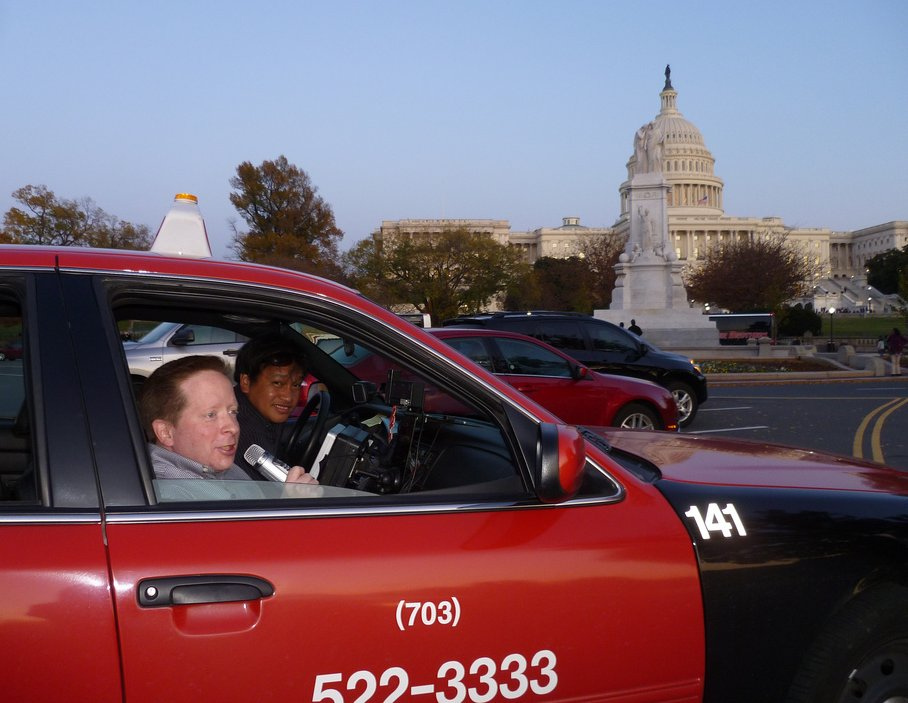
But in a growing number of cities and towns around the world, a very different type of karaoke experience is available. Some enterprising taxi drivers have installed karaoke machines in their vehicles.If you’re lucky enough to hail such an enhanced cab, you and your fellow passengers can sing while en route to your destination. Or you can board the taxi without even having a particular place to go, because if you’re like me, karaoke is your destination. 🙂 There is generally no charge for the opportunity to sing, beyond the fare that you’re already paying for the journey (although grateful passengers often tip extravagantly). And best of all, you don’t have to wait behind a long rotation of singers for your next turn at the mic.
As I will discuss below, I recently had the pleasure of taking a ride in a “karaoke cab” in Washington, DC. A search of Google and YouTube indicates that similar taxis have proliferated recently — sometimes using names like “Cabioke” to brand the multifaceted service that they offer. In addition to the capital city of the United States, they now roam the streets of such metropolises as Bangkok; Singapore; Taipei; Budapest; Las Vegas; Los Angeles; Dallas; Nashville; St. Louis; and Charlotte. They’ve even cropped up in smaller municipalities including Tacoma, Washington; Provincetown, Massachusetts; and Chico, California. So pervasive has this trend become that a filmmaker in Thailand is raising funds to make a movie about a karaoke cab. That one is so going in my Netflix queue when it comes out . . .
The man who made possible my Washingtonian karaoke cab experience is Joel Laguidao, who drives for the Red Top Cab Company in northern Virginia. A charismatic Filipino, Joel was recently featured with his vehicle on a segment of the American morning television program, the “Today Show”:
Joel first came to my attention this past summer, when one of my Facebook friends linked to an article about him on NPR’s website. Let me backtrack a little here, because my November 2011 ride with Joel marked the culmination of a nearly three-year quest.
2008: the Memorex fiasco
My odyssey began in December 2008 when I received a call from my friend Colin, who told me that he’d just taken a ride in a karaoke cab right here in New York City. A Google search quickly informed me that a fleet of six karaoke cabs was being dispatched from selected points in the Big Apple. It was a promotion sponsored by Memorex: if you sang and permitted Memorex to videotape your performance, you could earn a free ride in the cab. I would be only too happy to sing for my fare.
There was one problem: I soon learned that the special cabs were only operating in New York on a temporary basis, for a period of just a few weeks. The day on which I received the hot tip was, in fact, the final day of the promotion. Even worse, it turned out that the Memorex fleet of karaoke cabs had been dodging cable cars in San Francisco a month earlier, during the same time that I’d been visiting that city– and I’d been tragically unaware of their presence. So I missed out on them twice!
I regarded the Memorex debacle as a massive intelligence failure on my part. But in fairness, maybe there was no need for regrets. I looked more closely at the website that Memorex had maintained for its vagabond fleet; and I discovered that the singing took place in front of the cab while it was still parked at the curb. You would collect your free ride after you sang. But once you boarded the taxi, the karaoke would be over. How lame is that — a karaoke cab where you don’t actually get to sing inside the cab? As Lionel Hutz would say, that’s the most blatant case of false advertising since The Never Ending Story!
Regardless of whether one of the Memorex cabs would have provided a satisfactory experience, one thing was certain. With the expiration of the Memorex promotion, there were no karaoke cabs of any nature to be found in New York City. That appalling absence continues today: over 13,000 licensed cabs in New York City, and not a single one has on-board karaoke. If I wanted to become a singing passenger, I needed to broaden my geographic horizons. But that was okay; after all, traveling for karaoke is what I do.
2010: the Charlotte incident
My second failed attempt occurred in September 2010. I was flying from Newark, New Jersey to Rio de Janeiro. During that voyage, I was going to have an approximately six-hour layover in Charlotte, North Carolina where I was changing planes (Charlotte Douglas International Airport is a major hub for US Airways, the airline that was conveying me to Brazil). Knowing I would have all that time to kill in the Charlotte metro area, I was excited to learn of the karaoke cab servicing that region. A jaunt in it would be a memorable way to start my vacation. So I contacted the driver. We exchanged voice-mail messages. The message left by the driver (who shall remain nameless) said he would be “glad to pick [me] up,” and he added that I should call him back on Tuesday or Wednesday of the next week (my layover in Charlotte would be the Thursday of the next week) to advise him as to what time I would be arriving in his city. What I didn’t know yet was that I would never hear from Charlotte’s karaoke cab driver again.
The following week, with my departure to Charlotte fast approaching, I called him as instructed. I began to grow concerned when the driver didn’t respond to any of the three voice-mail messages I ended up leaving for him. In those messages, I had attempted to set up a time and place for him to meet me in downtown Charlotte (I felt it would be easiest if he met me there and drove me back to the airport). He was also informed of the time that my flight was expected to land. But as I boarded the plane to Charlotte, I still had not received confirmation from the driver that he would meet me later that day.
My arrival in Charlotte was on time. Immediately after deplaning, I put in a call to the driver, but his phone went straight to voice-mail. So I left a detailed message, and proceeded to the the ground transportation area in the airport. Time elapsed, and my phone didn’t ring. I tried calling the driver again, and again was greeted with his outgoing voice-mail message. Undaunted, I headed to the bus lanes and boarded an express bus to Charlotte’s central business district (What the hell else was I going to do during a six hour layover? CLT had not yet joined the emerging trend of airports with karaoke).
When I reached downtown Charlotte, the karaoke cab driver again failed to answer his phone. I even contacted his dispatcher, who had no better luck than I did in trying to track down the AWOL driver. In fact, she advised that she hadn’t heard from him all day. To this day, I have never heard back from the karaoke cab driver who stood me up in Charlotte.
Happily, though, despite the dismal start to my holiday, my ensuing excursion to South America and Easter Island turned out to be one of my all-time great vacations. Sometime I’ll tell you about my adventures on that trip — including my attempt to outrun killer dogs on Easter Island. Singing in a karaoke cab, however, remained an unfulfilled wish.
2011: redemption
When I learned about Joel and his karaoke cab in Washinton, DC, I just knew that this time things would be different. It helped that D.C. is much closer to New York than Charlotte is. It’s very easy to get down to D.C. from New York for a weekend trip (which I do several times a year; after all, I attended law school there, so I have many friends in the area and I retain an affection for the city). As a result, unlike with my one-time layover in Charlotte, I would feel no pressure to make my ride happen on any particular day. If things fell through for whatever reason, I could just try again.
Using my proprietary research skills, I managed to get in touch with Joel, and to speak with him on the telephone (The fact that he actually answered his phone was the first good sign. Joel is a genuinely nice guy). We quickly settled on a mutually convenient weekend for me to become his passenger.
On Friday, November 11, I took the train down to D.C. after work. The following afternoon, I met up with my friend Becca, who had agreed to serve as videographer for my groundbreaking taxi ride. We took the Metro to the Ballston stop in Arlington, Virginia (I chose that location because the Red Top Cab Company is based in northern Virginia and I wanted to make the pick-up point convenient for Joel, who did not yet know me.). At the appointed time, Joel Laguidao showed up with his cab outside the Ballston station entrance. Becca and I got in and took our seats, and we were off.
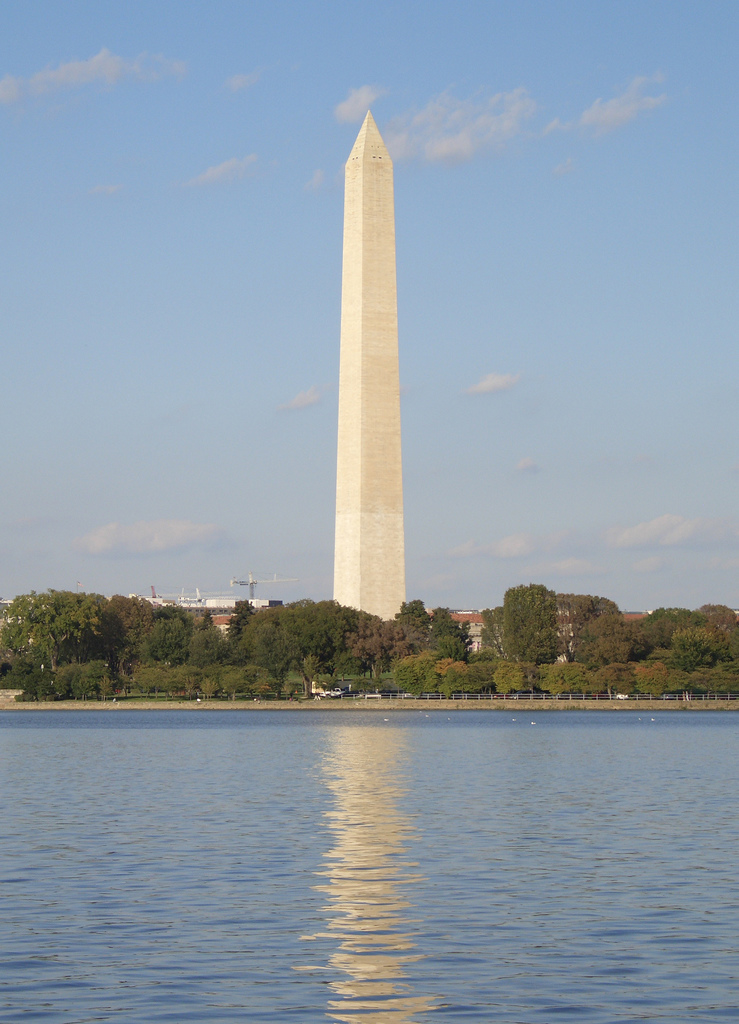
We didn’t actually have anywhere specific to get to, other than a general desire to end up in the city. So we spent nearly an hour as Joel’s passengers. Joel drove us over the 14th Street Bridge that spans the Potomac River, and we proceeded past the Washington Monument and towards the Capitol building. But I wasn’t in town for sightseeing. While glimpsing national landmarks through the window of Joel’s Crown Victoria, I was doing something that I’d been striving to make possible for almost three years: I was singing karaoke in a moving vehicle! My bucket list had just shrunk by one.
Here is one of my selections from that magical cab ride: John Lennon’s “Imagine.” Fittingly for that anthem of cooperation and harmony, Joel joined in with me (and I apologize in advance for the slight technical glitch with the audio):
And for a much different vibe, here I am performing “La Bamba”:
Joel is a passionate performer in his own right. Here you can watch him belting out a classic ballad by Journey:
Joel has a brand-new Facebook page! So if you like what you’ve seen of him here, please stop by his page and show him some love.
Now at this point, you may be wondering what recourse you may have if you do not live in, and are unable to visit, one of the locales where you can order a karaoke cab. Well, the obvious solution is to buy a car of your own with a built-in karaoke machine. Carpooling with your co-workers will never be the same. And if you scoff at my suggestion, I will have you know that someone else already came up with this idea, all the way back in 2003. In that auspicious year, the Chinese automaker Geely made a karaoke machine standard equipment on its BL (Beauty Leopard) coupe. And while you may not have heard of Geely, the company is not some piddling little buggy-maker; in 2010, it bought Volvo. Admittedly, the BL coupe is no longer in production. (Geely never responded to my email asking whether the in-dashboard karaoke machine is available on any of the models in its current product line.)
A friend recently asked me why I enjoyed the karaoke cab so much, given my previously-stated preference for playing to a crowd rather than singing in isolation. And admittedly, it would seem that the available listener base is quite limited when you’re inside the sealed environment of a motorcar. I guess I can’t completely explain my inconsistency. I’m pretty sure that my voice was audible outstide the vehicle, so that may be a part of it. But only a part, since no one on the street would have been able to hear me for any great length of time. Maybe this is just one of those instances where I have to say “I liked it,” and leave it at that.
By the way, another form of “karaoke on the go” is to sing while on a floating vessel. In October 2008, I took an evening karaoke cruise around Manhattan Island. I understand that karaoke nights are also widely held on international cruise ships, although I’ve never booked passage on one of those behemoths of the sea. One of my work colleagues has suggested that I should take advantage of this phenomenon, and that now that I’ve been able to check off six continents on my World Karaoke Tour, I should set a goal of singing in each of the world’s oceans. Hey, there are only five of them, so that would not be too long of a list to work through. I will say that I’m taking this proposal quite seriously.
Meanwhile, now that I have conquered both land and sea, I am looking upward for my next great challenge. My newest ambition is to sing karaoke on an airplane. I’ve worked out most of the details, and it would go something like this: Since commercial airlines have not yet exhibited the good sense to include karaoke among their in-flight entertainment options, I will need to provide my own instrumental music and lyrics. So I will need to be on a flight with wi-fi; then, using my laptop, I can log on to one of those internet karaoke sites. Ideally, I would like to stream a live video feed of my performance so that people on the ground can serve as a virtual audience. Now, I realize that my fellow passengers will be unlikely to indulge even a few minutes of a singer in seat 25A. To avoid provoking air rage, I may need to hole myself up in the lavatory, as I join my own version of the “mile-high club.” This plan is complicated and has a lot of moving parts, but it just might work!
Whether or not the H-Bomb phenomenon takes to the skies, of one thing I’m sure: I will ascend no higher than cruising altitude. Space will not be the final frontier for me. I hate amusement park rides such as roller-coasters; I get motion sickness when subjected to those g-forces (although curiously, I rarely feel airsick when flying through turbulence). So I could never become an astronaut. Even if I somehow acquired the boatloads of funds that would enable me to afford a private spaceflight, I could never bring myself to sign up for such a mission. The H-Bomb will have to remain earthbound. But there’s a whole lot more of the world left to cover on my World Karaoke Tour!
UPDATE: I’ve discovered that there’s a New Zealand-based alternative rock band called “Karaoke Taxi”! As far as I can tell, however, that band has never actually performed in a taxicab. 🙂
My scenic ride in Joel Laguidao’s karaoke cab included views of the Washington Monument.
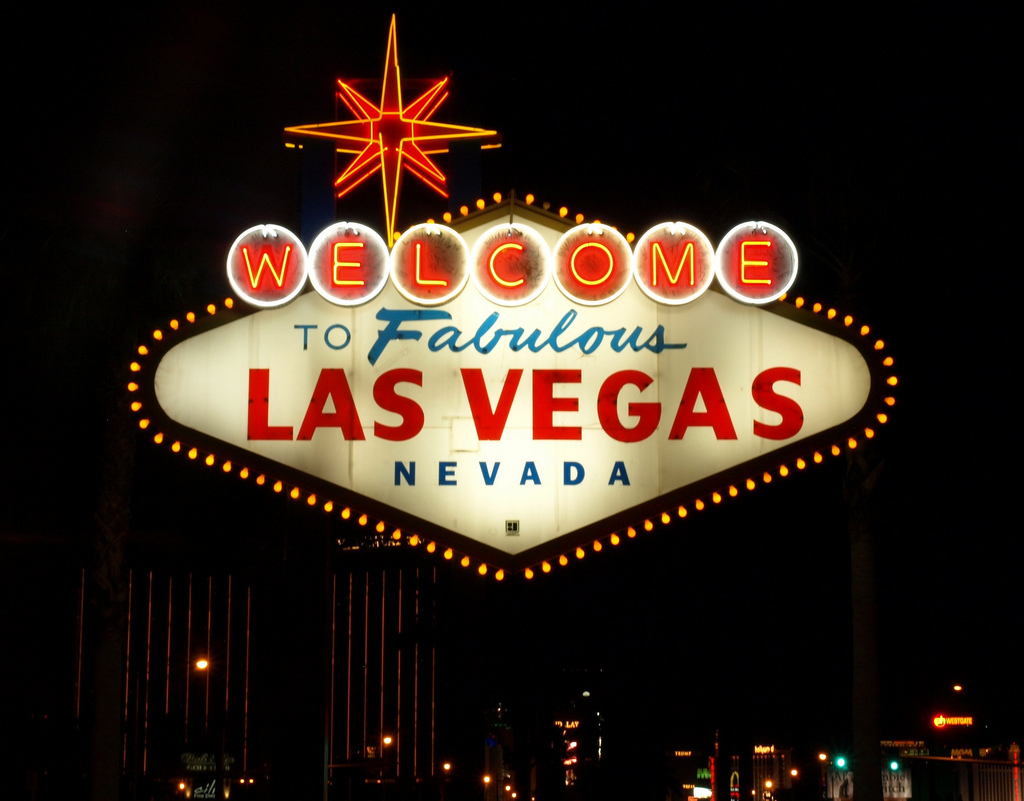
is quite possibly Las Vegas. Sin City, of course, is fun for many reasons. But for my money, karaoke is right up there with its other attractions. Many outstanding karaoke venues can be found on or near Las Vegas Boulevard, popularly known as the Strip. Here are two of my favorites, both of which offer unique experiences:
Zinger’s Rock ‘n Roll Cafe
The Rock ‘n Roll Cafe is located in the Hawaiian Marketplace, near the Harley Davidson Cafe and across the street from the Aria hotel. The special attraction is that the seating and performance areas are outdoors. So when you’re singing, passersby on the sidewalk can not only hear you; they can see you as well. Many people who are walking past will stop and gather at the railing that surrounds the periphery of the bar’s seating area; and they’ll stay to watch the singers. So when I’m singing at the Rock ‘n Roll Cafe, I enjoy the challenge of getting drunken revelers who happen to be walking down the Strip to stop what they’re doing and cheer on the H-Bomb!
I don’t yet have any videos of myself performing there, but here’s a video I found on YouTube that will give you a good idea of what this place is all about (and I’m really digging the stage name of the male singer here. He calls himself “Smoothini the Ghetto Houdini.” It makes “H-Bomb” sound pretty ordinary).
Oh, and best of all, the Rock ‘n Roll Cafe offers karaoke seven nights a week!
Bill’s Gamblin’ Hall & Saloon
Bill’s is not like those sprawling, theme-oriented mega-hotels that are now prevalent on the Strip. This place has character! And it also offers a karaoke experience like no other. The karaoke lounge is immediately adjacent to the casino, and the sounds of the karaoke singers can easily be heard on the casino floor. So when you grab the mic there, you are the entertainment for the gamblers! I think that’s pretty cool.
No matter where you choose to sing in Vegas, the vibe of the city (i.e., everyone is there to party) makes it even more enjoyable. In addition, Las Vegas has a long and storied association with music, going back to the days of Elvis and the Rat Pack. I believe that the city’s contemporary karaoke scene fits firmly into that tradition. 🙂
So I love singing in Las Vegas; and I am therefore especially excited to announce that I have just made plans to return to Vegas for several days in August 2012. The occasion for this visit will be the second annual Trivia Championships of North America. But I will find ample time, in between quiz bowls and other trivia events, to do some karaokeing! (I’ll also be fitting in some sessions at the blackjack table; and I look forward to checking out the brand-new Mob Museum, officially titled the National Museum of Organized Crime & Law Enforcement, which is slated to open in February 2012).
Hello there! I'm an attorney and worldwide karaoke singer who's based in New York City. I've sung karaoke in 77 countries around the globe, on all 7 continents, plus Easter Island - as well as all 50 U.S. states! This website chronicles my World Karaoke Tour as well as my general travel adventures. Learn more
 The wheel. The printing press. The telephone. The automobile. Aviation. Radio and television. The internet. These are among the transformative inventions that improved the quality of people’s lives and changed the course of human history. If you ask me, karaoke belongs on that list. But where did it come from?
 Named for a Shirley Temple movie, Dimples opened its doors in 1982, and its customers have been singing their hearts out ever since. For anyone serious about conducting a World Karaoke Tour, Dimples is a required destination. If you want to explore La-La Land in all its glory, a visit to Dimples is just as integral to the Hollywood experience as the Universal Studios tour or Grauman’s Chinese Theatre.






 H-Bomb's Worldwide Karaoke